
My Clock Didn’t Change for Fall Back – What Happens?
Posted On: November 5, 2016Most people’s phones automatically change the time during the daylight time saving season, however other clocks need to be manually changed. There are times even my clock didn’t change for fall back – and I get a bit anxious if it did or not and would I be late or early if I have the wrong time on my clock…..
The November time, change, also known as ‘fall back, ‘ forces the time to move back into time by one hour. Because we “gain” one hour, if we don’t change the time on our watch or clock in the fall, we would be E-A-R-L-Y for church on Sunday or work or school on Monday!

My Clock Didn’t Change for Fall Back – What Happens?
If you do go to the US for business or onsite client visits on the first weekend of November (2am on the first Sunday of November, to be exact) and do not know about the time change, or your manual clock on your wrist watch or hotel alarm clock doesn’t get changed, you are not really at a loss getting to work one hour early on Monday. Being early in the U.S. is always better than being late (which is what would happen if the same situation happened during Spring Forward in March).
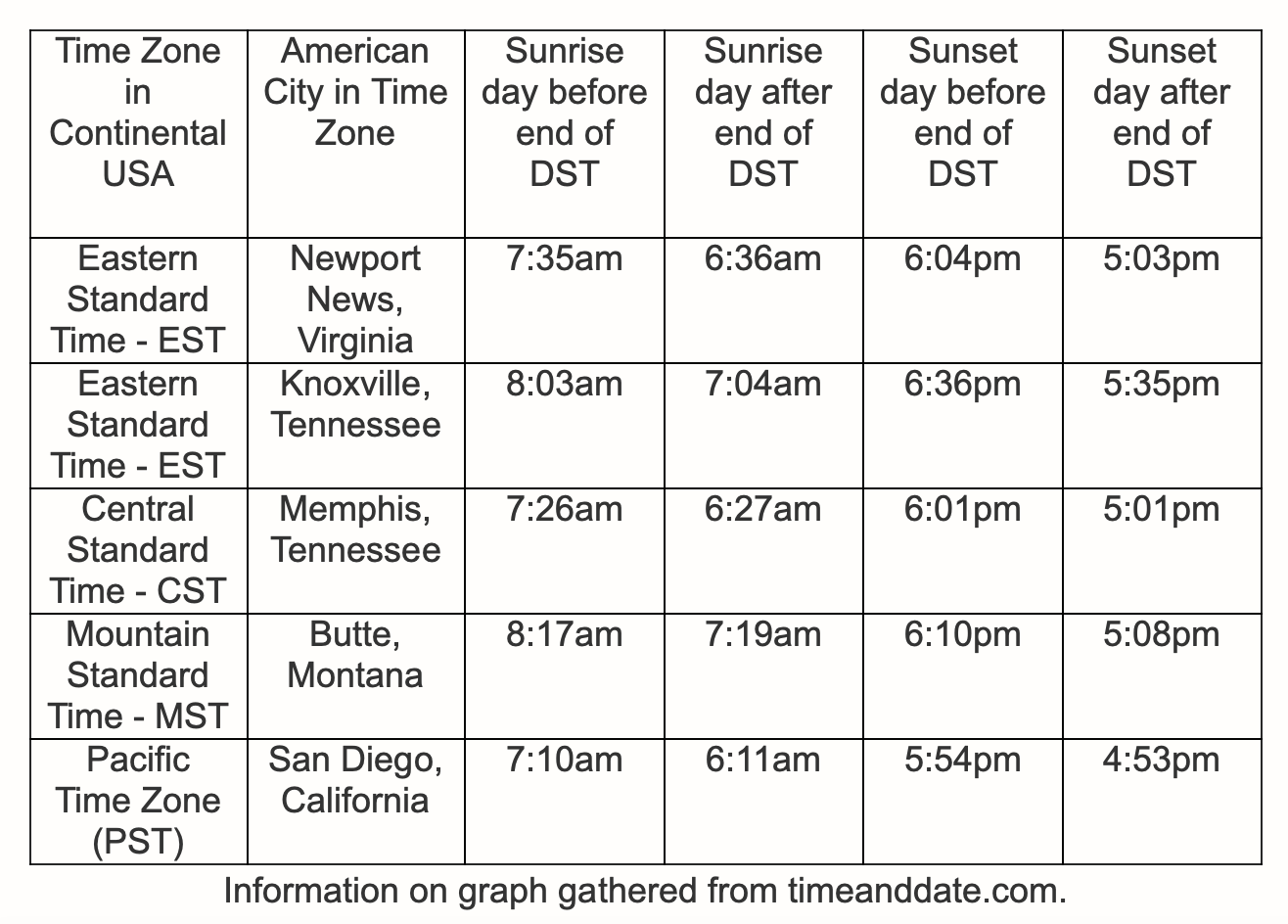
When is the sunrise and sunset after Fall Back?
While travelers to the US may not easily notice this, due to the time being shifted by one hour, the sun will rise one hour earlier on the first Sunday morning after fall back, and the sun will set one hour earlier due to the end of Daylight Saving Time (DST).
 |
| Cities featured on the grid, circled on this map. Click on the map to see a larger size. Map courtesy of vidiani.com. |
As the sunrise and sunset times change, but the times children go to school or adults go to work do not, this time change not only plays with our internal clocks but also our external environmental expectations.
Time Change & Waiting at the Bus Stop to Go To School
If a high school student in almost any time zone has to catch the bus to school at 7:00 am everyday, the Friday before the end of DST, he or she will be waiting in the dark at a bus stop, but the Monday after fall back, the same child waiting to get on the bus at 7:30am will be waiting for the bus as the sun has risen (it will be light out).
Coming Back from Work – In the Light or In the Dark?
However, if we look at an adult’s schedule in most time zones who typically gets out of work at 5 pm, the Friday before Fall Back, the adult would be getting out of work and probably arriving home before sunset. However, in all time zones, that same adult would most likely be getting of work, walking to their car, and driving home during dusk or an already darkened sky.
Do Americans like to change their clocks?
I think people are used to it, but not many people really like it due to it messing up our sleep patterns. Around fall back and spring forward each year, news channels tend to talk a lot on this topic, as in the video below. You, as an expat working in the United States can also feel free to make small talk on this topic. You may learn a lot about American’s mindset toward this topic!
Maybe you have also wondered….
“What kind of small talk can we make about daylight saving time? Can we ask how is daylight saving time?”
This insightful question asked after a US culture training on small talk left me speechless for a moment, with an answer of, “Well, we do make small talk about the end of day light saving time, but not quite like that…. give me a second…”
Questions to use for “fall back”
(First Sunday in November in the northern hemisphere):
Friday or week before the time change:
- I am looking forward to the time change only so my daughter/son can get on the bus when it’s actually light out….
- I’m not looking forward to coming home in the dark next week….
- Only a few more days left to come home before the sunset…..
(After the time change, the sun would set one hour earlier. In some areas, the sun may set before 5pm.)
Anytime during the first week of the time change:
- Have you gotten used to the time change yet? (Avoid asking it using the word “timings.” The word “timings” is not common in American English.)
- Were you able to sleep til the alarm or did you wake up early?
- It’s nice to get an extra hour of sleep, isn’t it?
- Wow it feels so weird with the sun setting earlier. I hate when the sun sets at 5, don’t you?
Ask Tuesday- Friday after the time change:
- Was it dark out when you went home yesterday/Tuesday/this week?
On Monday to colleagues you already know who have children:
- Wasn’t it nice that the sun was out when the kids got on the bus this morning?
- It’s nice that it wasn’t dark when the kids got on the bus this morning, wasn’t it? </span>
Ask only to colleagues you are close to who you already know go to church OR you met them at church:
- Were you on time for church or early?
- I forgot to change my clock and was early for church on Sunday, what about you?</li>
Ask Anytime:
What is the time difference between the US and India?
How many hours are between India and the USA after daylight saving time ends? –> 10.5 hrs
What is the time difference between India and the USA during daylight saving time? –> 9.5 hrs
This list is not exhaustive. Feel free to reach out to us to share about other questions or topics you have discussed with your colleagues around this time of the year. I am happy to have a discussion with you!
Jennifer Kumar, author of this post, provides U.S. Culture Training to offshore teams working with American counterparts.
Our Small Talk course, Building Trust and Good Relations With US Americans, teaches individuals how to engage in casual conversations with others. It covers topics like initiating conversations, asking open-ended questions, active listening, and body language. The course helps participants build rapport and establish connections with people they encounter in social settings. Overall, a Small Talk course is a valuable investment for anyone who wants to improve their social skills and feel more comfortable in various social situations.
Thank you for spending your time here.
Related Topics:
Content calendar vector created by pikisuperstar – www.freepik.com
Published 2016, Updated 2022, 2023, 2024, 2026
Tag cloud: why didn’t my clock change, what time does it get dark, sunset time, what time does it get dark today, if I forget to set my clock back will I be early or late, daylight saving time in USA, what time is sunset, my clock didn’t go back, time change happens when, daylight savings sunset time
Share
Categories
- Build Your Career
- Business English for Non-Native Speakers
- Case Studies
- Coach Yourself
- Coaching For Coaches
- Global Careers
- How You Succeed with Us
- India: Culture & Lifestyle
- India: Work Culture
- Leadership Skills
- Personal and Career Confidence
- Uncategorized
- Understand American Psyche
- USA & India: Elevate Relationships
- USA: Business Culture
- USA: Expat Life
- Well-Wishers & Supporters
Related Posts
-

US – India Holiday Calendar 2026
September 21, 2025 -

General US Holiday Calendar
October 11, 2022 -

Telugu Language and Culture – run4telugu
August 5, 2021 -

Small Talk for the 4th of July Holiday
June 30, 2021 -

What is Pioneer Day?
July 24, 2020 - About Authentic Journeys
- Articles
- Business English Consulting
- Coaching Strategies
- Conflict Management
- Cultural Studies
- Email & Business Writing
- Expat Programs
- Get and Keep US Clients
- Goal Setting
- ICF Core Competencies
- Idioms and Phrases
- Indian Holidays
- Inspirational Stories
- Managing Global Teams
- Media
- Media Engagements
- Move to and Live in India
- Move to and Live in the USA
- Negotiation Skills
- News Articles
- Offshore Teams
- Presentation Skills
- Rapport Building With Americans
- Self-Help
- Small Talk
- Solution Focused
- StandUp Meetings
- Testimonials
- Training Programs
- US English
- US Holidays
- Working Across Cultures
- Working with Indians